


one more contemporary dance review

Updated: Mar 11, 2022
Adi Boutrous explores the relationship between group and individual, uncovering further layers of masculinity in an arresting fusion of contemporary dance and acrobatics.
It is rare to expect that we can leave a contemporary dance performance with answers. Many great artists believe that their role is to encourage questioning, and Israeli choreographer Adi Boutrous proves to be no different. In One More Thing, he is accompanied by three male dancers in a journey of falling and catching, collision and embrace, inviting us to reflect upon the existing codes of male identity. Four men navigate the complexities of masculinity through a considered combination of force and tenderness, questioning their relationship to one another and grappling with their own identity.

image: Ariel Tagar https://www.adiboutrous.com/one-more-thing
The piece opens on an intimate moment showing the quartet holding eye contact. Eventually they lower to their knees in perfect synchronicity and begin a motif of repeated movements echoing a traditional folk dance, reinforced by Boutrous’s own sound design. Immediately we are presented with images of tradition, unity and culture. The movement quickly develops into an arresting fusion of contemporary, breakdance and acrobatics with the dancers remaining in contact through a series of complex lifts and shapes.
His unique movement quality is the perfect host for this discussion.
There is an almost primitive quality to how the dancers move as effortlessly on their hands as on their feet, this animal like physicality suggesting strength, power and virility. Boutrous choreography is distinguished by the stunning juxtaposition of opposing movement qualities, as seen in the gentle placement of hand on body despite the strength and force in the dancer's movement. This attention to detail is touching, simultaneously demonstrating male virility and profound devotion to one another.
The heavy use of repetition creates a strong sense of being stuck, suggesting themes of conformity, fulfilling an expectation and resistance to break tradition. Due to the physically demanding nature of the movement, the dancers grew genuinely tired. This added a layer of frustration and desperation to the repeated motifs with an urgency to end, give up, or be stopped.
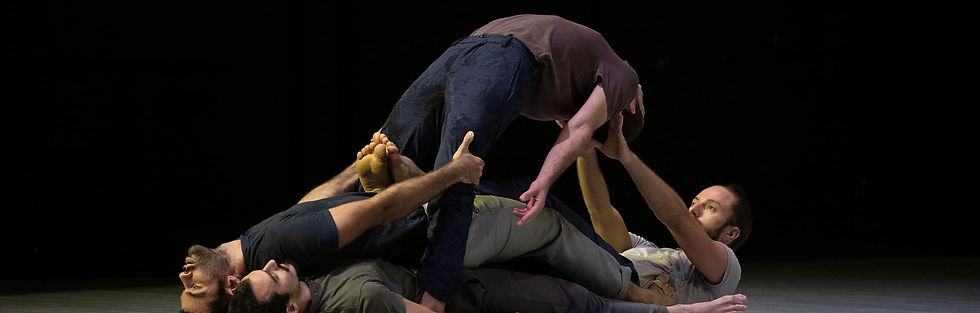
image: Ariel Tagar https://www.adiboutrous.com/one-more-thing
Carefully crafted, emotionally engaging motifs.
Boutrous has an exceptional ability to alter the tone on stage, which he achieves in One More Thing through the relationships between his performers. From strong ensemble choreography where we establish their relationship as a quartet, a dancer is suddenly isolated and moves in solitude.
At first I found the abrupt transition from quartet to solo to be clumsy and unimaginative. However, as the relationship between the four developed throughout the performance, I began to find the brutal switch incredibly moving. After spending time on building a trusting, devoted relationship he makes the audacious decision to rip one dancer away from their supportive cluster, leaving us with a profound sense of abandonment, loneliness and loss of connection. It pained me to watch this happen repeatedly, my only solace to be found in the captivating solos that allowed the dancers the freedom to express their own experience.
These moments were intensified by the simple choice to have the three unmoving dancers watch, either from their place on stage or sitting outside of the performance space, causing us to question a change in the soloist’s relationship with the group. Observation could suggest scrutiny, judgment, intrigue, pity, anticipation, compassion, the list is not exhaustive.
Questioning the individual’s place in the group is a recurring theme in One More Thing, with the dancers’ relationships to one another never being made clear. We are presented with the image of lovers through moments of intimate touch and almost erotic positions, of brothers or friends through moments of play, of enemies when at moments the intensity verges on aggression. The flowing impermanence of each image and suggested relation leads to the conclusion that the bodies represent more than just the individual.
He tells us nothing we didn't already know.
The piece draws to a close by repeating motifs from the opening section, allowing us to indulge once again in Boutrous’ impressive choreography. Although the movement was familiar, layers of fatigue, relief and deeper connection gave the repertoire a breath of fresh air. The audible grunts from the dancers as their tired bodies met, with a less controlled force this time, present them as individuals experiencing the very tangible effects of masculinity that have been felt for decades.
One More Thing felt like a gentle call to action. His humble and honest approach to the subject of masculinity and group identity offered the opportunity to truly reflect on what we already know. This was refreshing and while I am left wanting answers, the air of support and connection between Boutrous and his dancers suggest an alternative way forward in tackling existing codes of masculinity.

image: Ariel Tagar https://www.adiboutrous.com/one-more-thing

Comments